Designing for complex and edge case scenarios at the VA
Summary
Caseflow is a suite of products that helps attorneys, judges, and administrative staff across the Department of Veterans Appeals process appeals and serve Veterans and other appellants more quickly, efficiently, and effectively.
There are several types of appeals that the Board of Veterans' Appeals processes. One of the more complex types our team was focused on understanding and implementing was "Contested Claims".
A Contested Claim exists when granting benefits to one claimant requires either a denial or payment of a lesser amount to another claimant. A claimant could be contesting either the other claimant's entitlement to the benefit or payment the other claimant is receiving.
All claims where entitlement to the benefits is based on the claimant's relationship to the Veteran (e.g. spouse, parent) are considered Contested Claims if two people allege to be the Veteran's legal surviving relative and they file a formal claim for the same benefit. These claims require special procedures and additional input from various VA teams, making them more complicated to manage.
Through summer-fall 2021, I led our team to understand the legalities of Contested Claims through discovery research and helped scope the work into multiple phases. I was able to support the team with implementing the first phase of this effort before moving to another team on Caseflow.
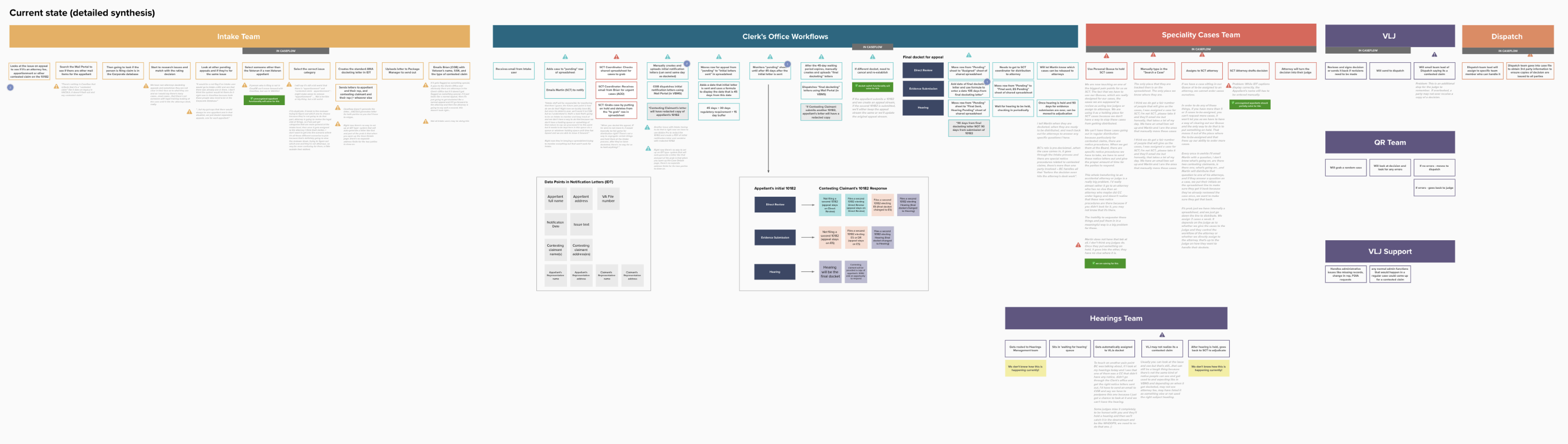
Synthesis of discovery activities to map out the current state of handling Contested Claims
Key Contributions
- Led design and research activities over ~6 months, collaborating closely with our end users and engineering teammates
- Conducted extensive discovery research and mapped out the current state, pain points, and opportunities
- Led design and research work for our first phase – creating a visual indicator to help identify Contested Claims
- Sequencing and prioritization of work, including ticket management and refinement
- Conducted extensive discovery research and mapped out the current state, pain points, and opportunities
- Led the scoping and prioritization of the overall initiative, including several presentations to VA leadership to get buy-in for our phased approach
- Onboarded a new designer onto the work and coached them through research and design work
Key Outcomes
- We were able to get buy-in for our phased approach and I was able to help the team identify a way to deliver value quickly by helping Board users identify a Contested Claim through a visual indicator – a feature that provided great value to multiple teams at the Board
Reflections
It's important to identify ways to deliver value early and often to help build trust with our government partners. A seemingly small change like a small visual indicator provided great value to multiple teams, and through this project, I learned a lot about thinking in increments, scoping, and prioritization.
Process snapshot
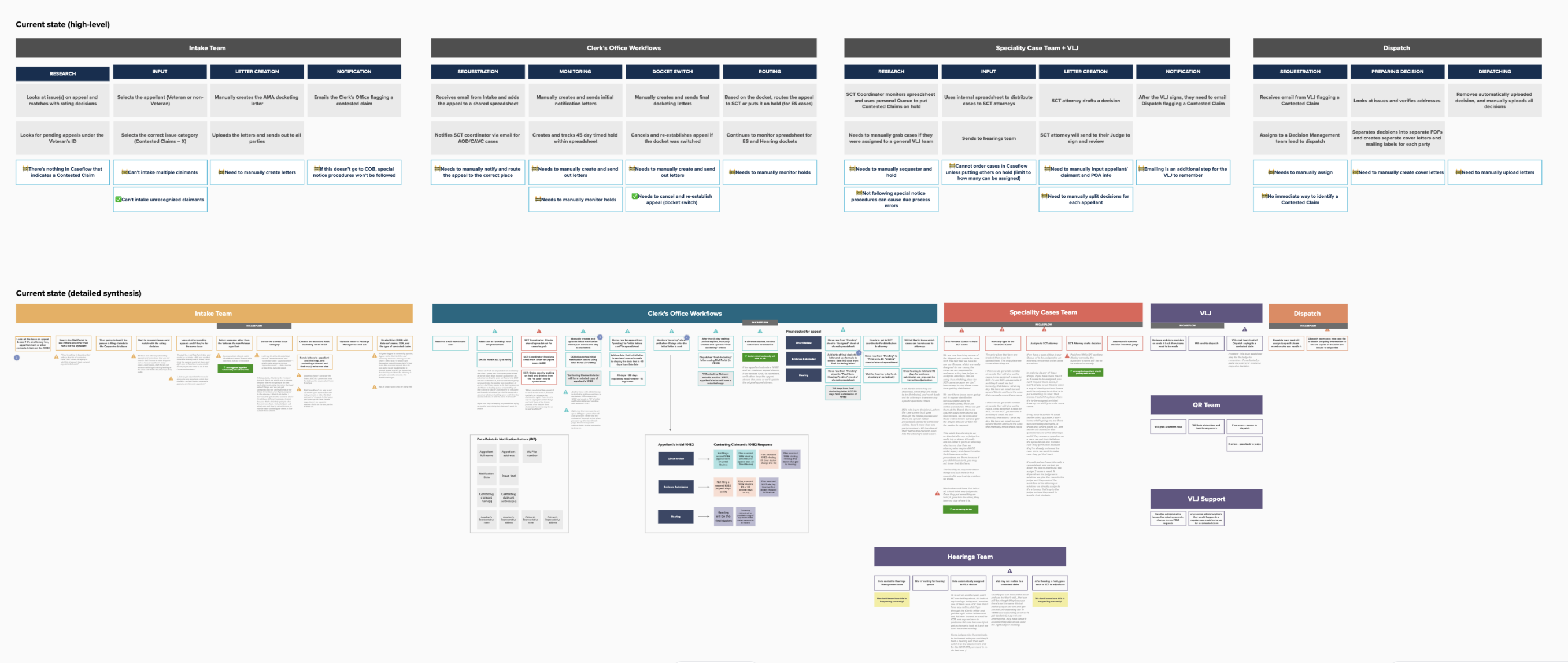
We began with a planning phase where we explored the problem space and identified opportunities to inform what we would build. This phase included activities such as discovery research, stakeholder interviews, user and staff interviews, competitive analysis, contextual inquiries, and content or design audits. This allowed our team to truly understand different user groups' needs and helped us better understand their pain points. The result of all of this research was a process map like the one below, which illustrates the end-to-end process of user workflows. Although the individual cards are not legible, it gives a sense of how many steps and workarounds were involved in processing Contested Claims. This artifact helped our team get a bird’s eye view of the process, and identify patterns to define areas of opportunity.
Following our process mapping work, we synthesized our findings into a report to inform the next phase of work. The artifacts below are screenshots from a research deck we presented to VA stakeholders to discuss pain points and opportunities. We use this approach to help strategize on next steps and align the whole team on the needs and priorities of users so that everyone has the same foundational understanding of problem areas.
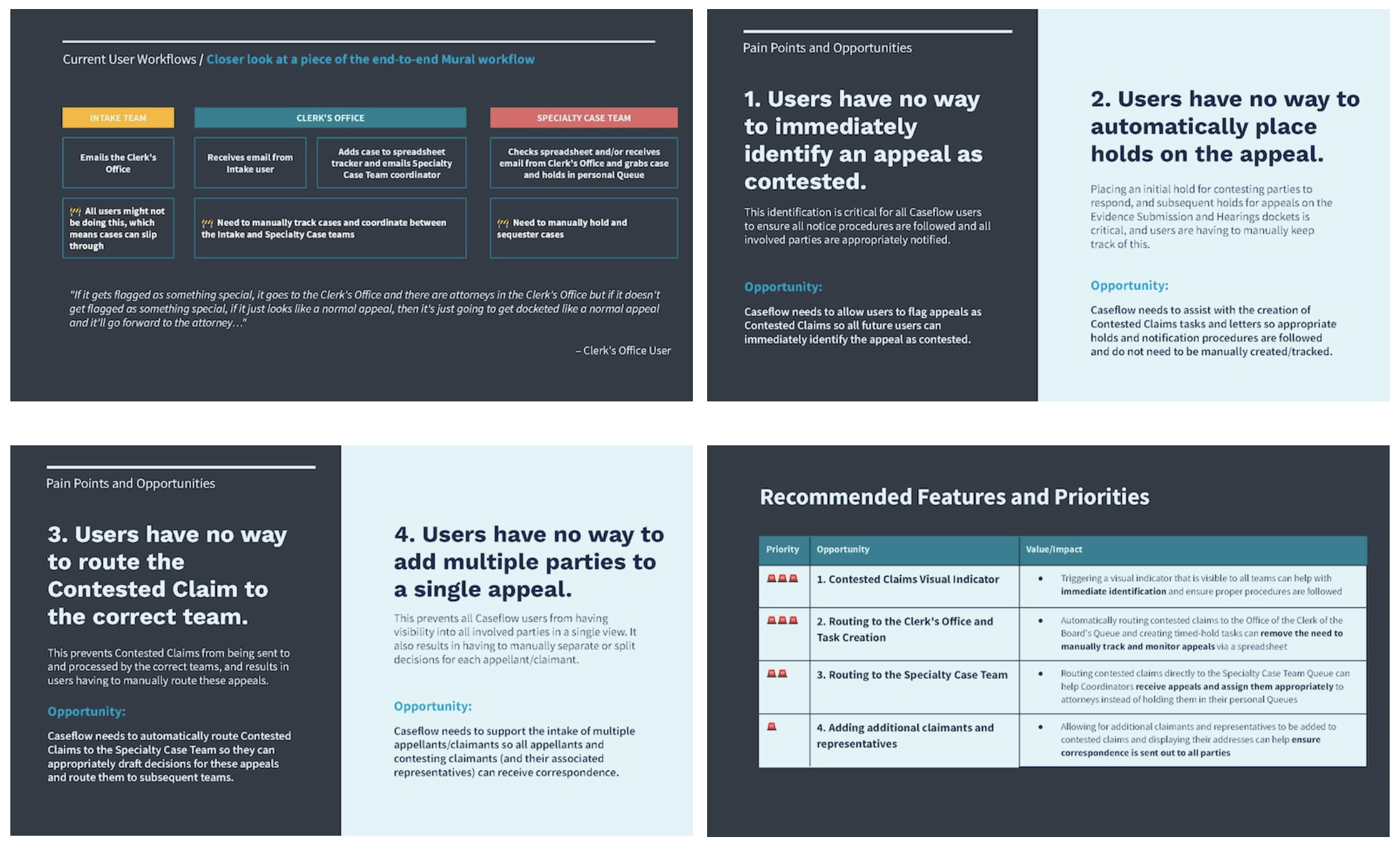
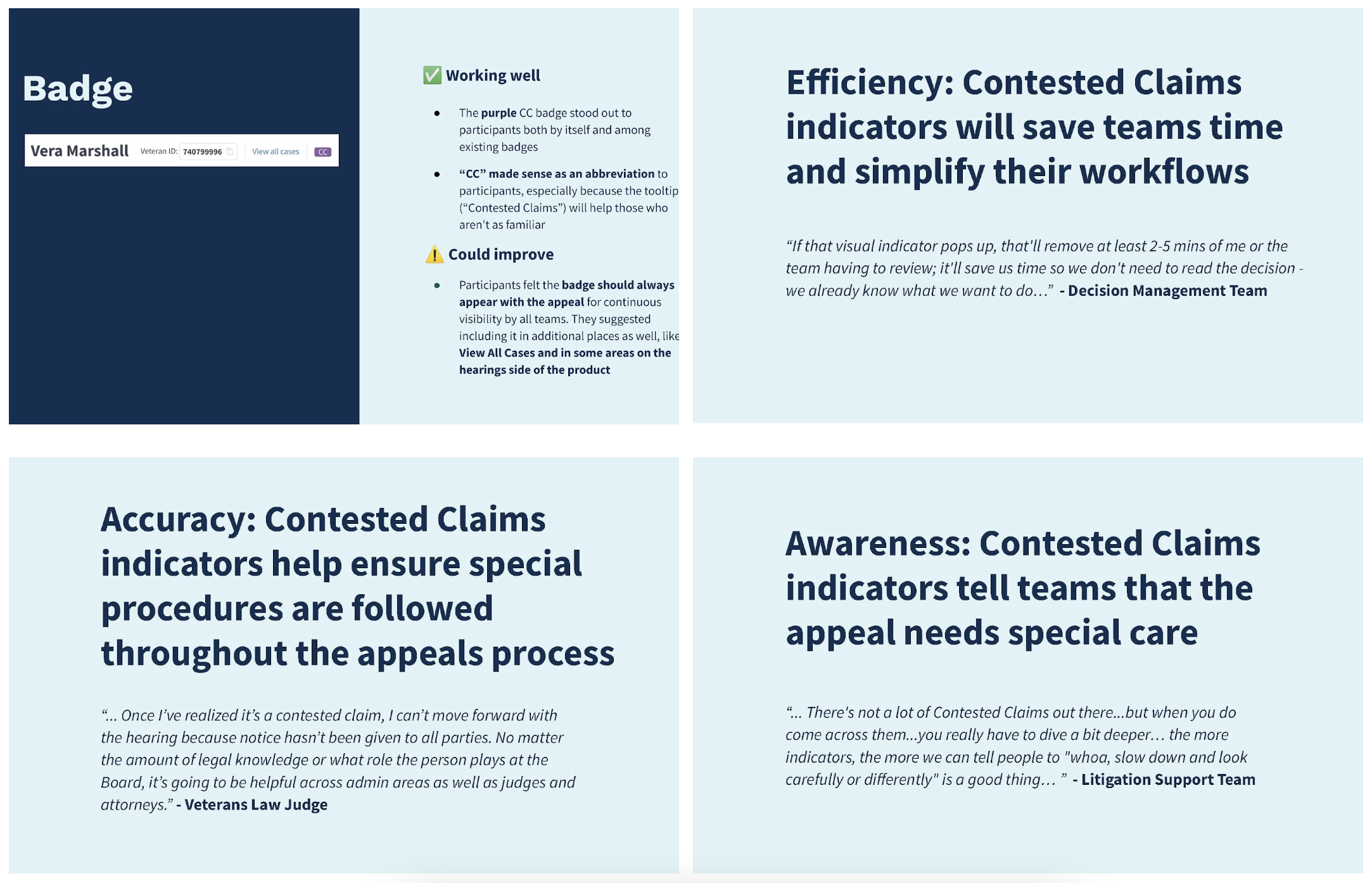
Following our planning phase, we then moved into our interaction design phase which involved taking the information gathered during the planning phase and using methods such as sketching, prototyping, and testing to help deliver a launched product. As noted in the slides above, one of the pain points identified during our research was that users did not have a way to easily identify Contested Claims and we recommended a visual indicator be developed so teams could immediately identify these claims and ensure the proper procedures were followed. The artifacts below show the Contested Claim indicator in various parts of the workflow. We tested several different indicators to validate that they were helpful to various teams, determine which parts of Caseflow needed to display the indicators, and identify any other needs related to the indicators.
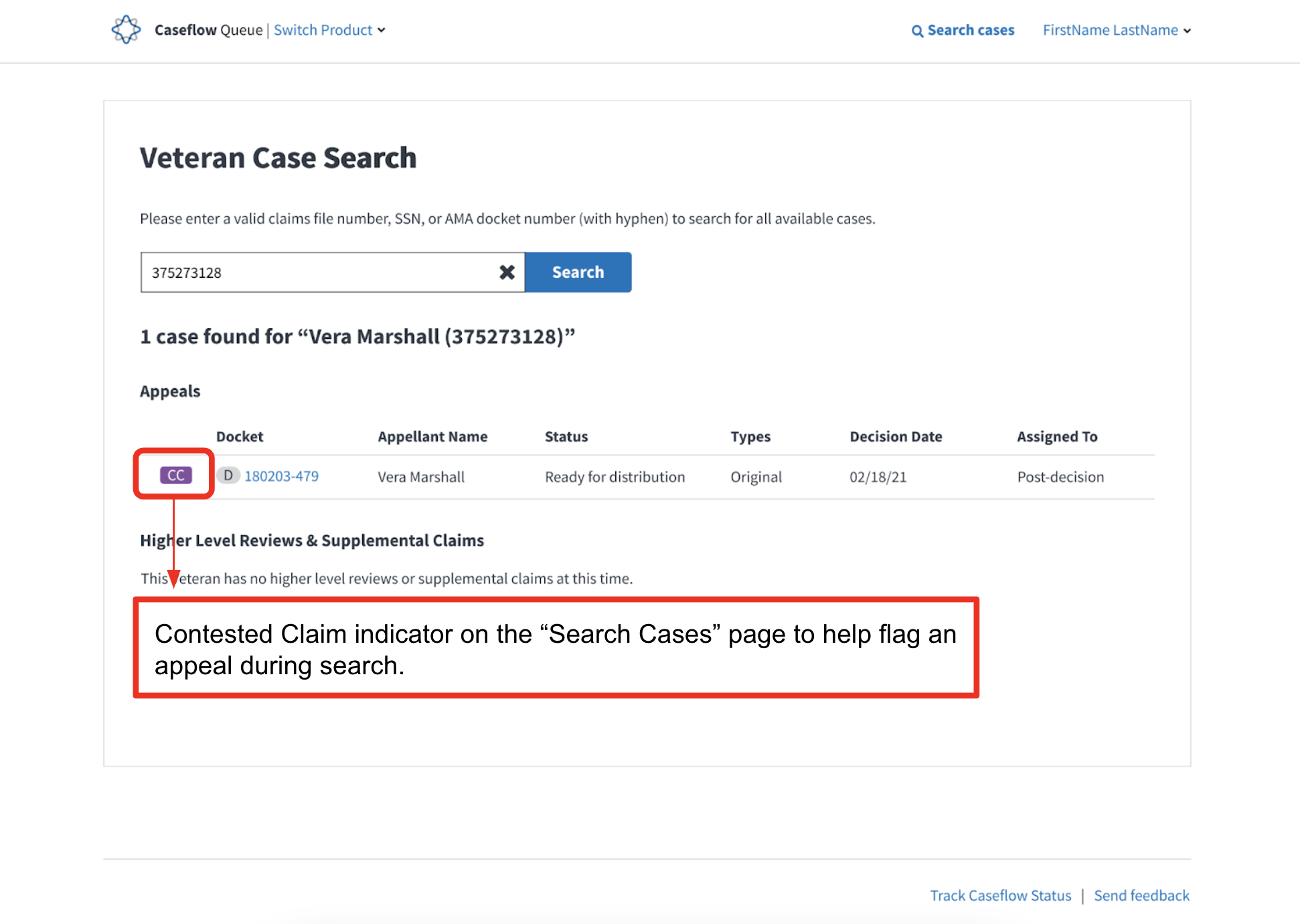
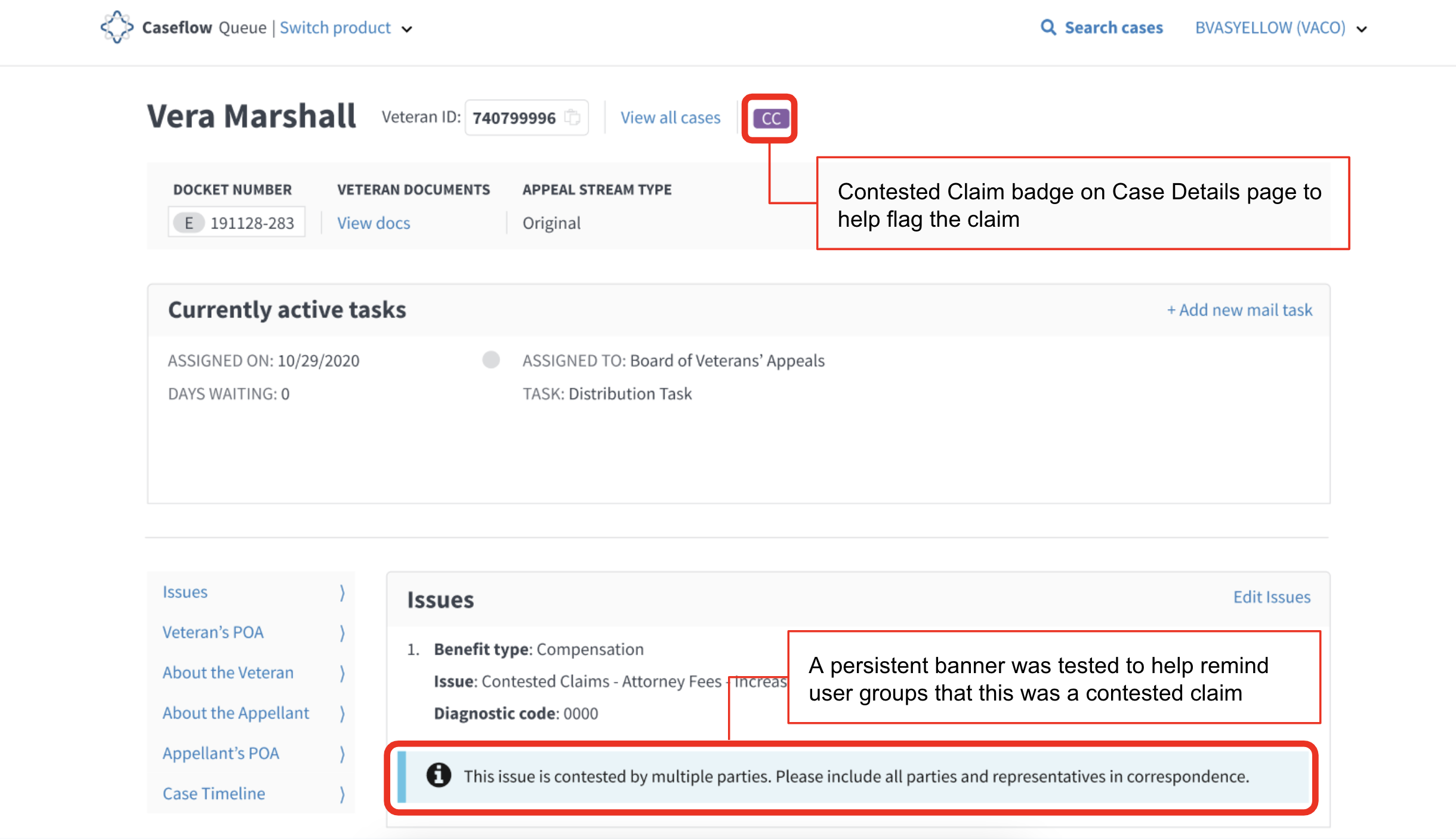
As the Contested Claims indicator affected several teams across the BVA, we wanted to test this indicator with multiple teams in order to understand everyone’s needs and ideas. While we would generally test these types of designs through 1:1 usability testing, we felt our research could benefit from cross-team perspectives so we held four research sessions with various teams based on either the phase of the appeals process or similar roles or functions.
Once we had completed our research sessions, we conducted in-depth analysis and synthesis so we could capture patterns and needs across the various teams and presented our findings to VA stakeholders. The artifacts below are slides from that presentation that show our key findings of what was working well and what the testers felt we could improve. As a result of this research, we determined that the badge designs were ready to be implemented and they went into production.